
When Leaving the Field Means Rebuilding Your Identity
Kate Burton
With more than 20 years of experience in the humanitarian sector, Kate Burton has worked with organisations including the United Nations, the ICRC, Médecins Sans Frontières (MSF), and several grassroots NGOs in some of the world’s most complex conflict environments.
Over the last ten years, her work has focused on investigations following critical incidents affecting civilians and humanitarian actors, including kidnappings, detentions, and targeted attacks. During her time with MSF, she specialised in investigating military attacks and drone strikes, combining operational field experience with technical expertise in OSINT investigations, forensic science, and international humanitarian and human rights law.
Multilingual and working across diverse cultural contexts, she brings a rare combination of operational, analytical, and legal expertise to the humanitarian field.
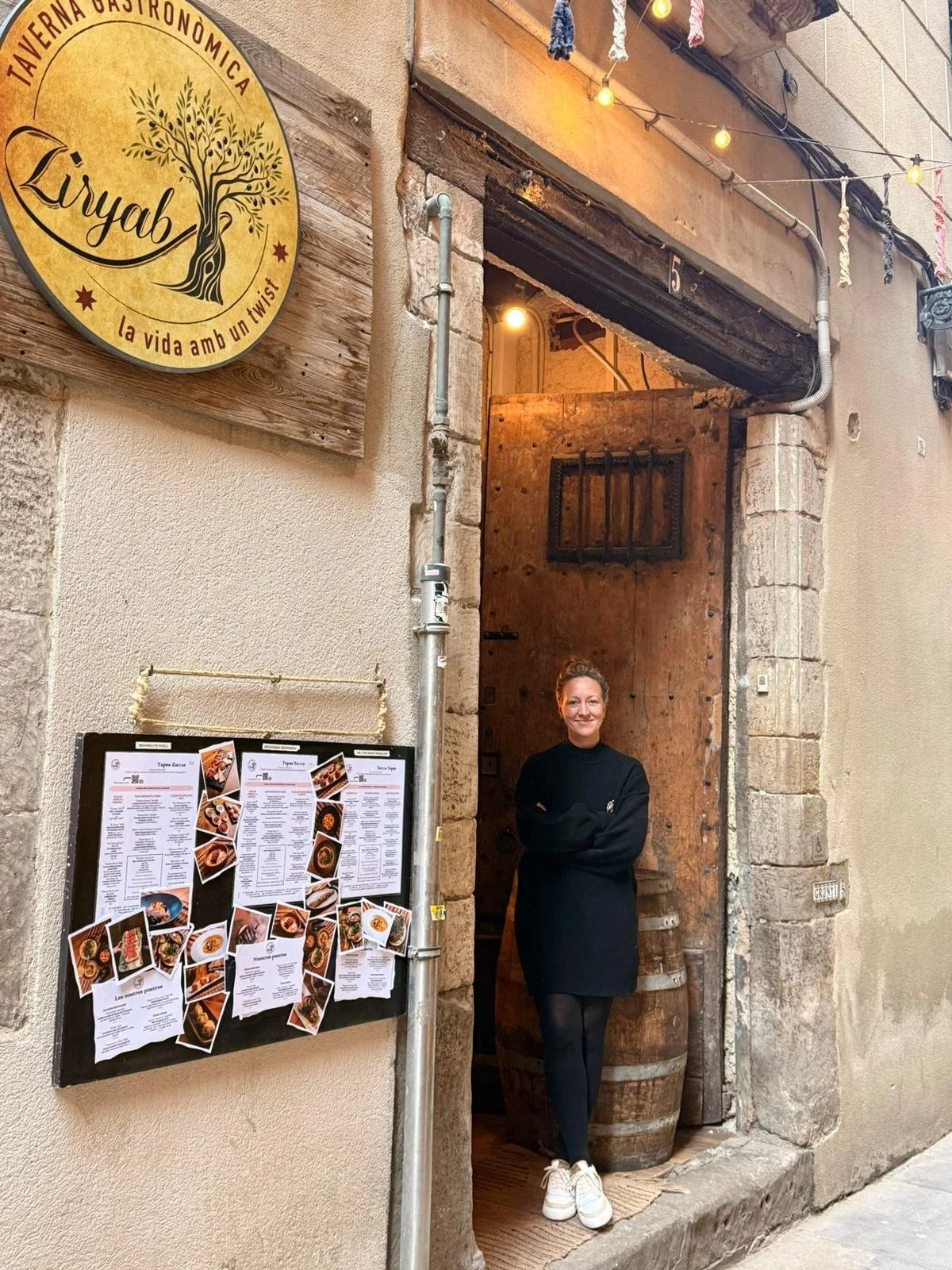
Alongside her humanitarian career, she is also the co-owner of a restaurant & a café in Barcelona where she has settled. A social inclusion project where half of the team is profoundly Deaf. For over 13 years, the restaurant has promoted awareness of Deaf culture, the use of sign language, and the inclusion of people with disabilities, receiving several awards for its social impact.
Q1: When did you first realize that a professional transition had become necessary?
I think behind this transition there has been both a driving factor (choice) whose seed was sown over two decades ago, and a push factor (need) that started to become more accentuated as I neared the 10 year mark of working and living abroad, particularly in highly insecure contexts and dealing with humanitarian issues that took an emotional toll.
The driving factor was the desire that I had since I was a teenager, to one day own a bar or a restaurant. I started working as a waitress or bar person as young as 16 years old, to make some money on the side and be more independent from my parents. When I took a gap year before university, I continued to find waitressing jobs, and when I did my university degree, I spent more time serving drinks to people than I did drinking them myself. I was determined to be autonomous and thereby be able to make my own life choices without having to justify them to anyone. For me, the hospitality sector gave me my freedom to travel and do as I please. Every summer at university, I travelled to different countries to gain work experience and learn languages, while in the evenings I made money working as a waitress.
When at university, I made a pact with a friend that one day, we would open a bar, on a beach somewhere, perhaps in the Caribbean! Even if it didn’t end up being there exactly, I believe this thought was always with me. I have always very much enjoyed the people-centred nature of serving people at a restaurant, and now this has been even further enriched by the fact that – by owning a restaurant myself – I can create and curate what I believe to be a special and memorable experience for people.
When I finished university, the first thing I did was head to Latin America, where I worked a summer camp in the fields of Cuba helping the campesino farmers, following which I went to work as a volunteer in an inspiring and proactive human rights NGO in Mexico City. I had zero experience in the humanitarian sector, but knew it was what I wanted to do. So I offered myself to work for free, and in the evenings I worked as a waitress in downtown Mexico City to pay my rent. This was my entry point into the humanitarian sector. But that drive to set up my own place one day, that pact I made with my friend, stayed with me throughout my humanitarian career.
The second factor was the push factor, that became increasingly overpowering and loud in my head. Years of living and working in war zones entailed a number of different events and realities that had various levels of trauma or potential trauma attached to them: being the victim of a kidnapping, being at the site of a bombing and seeing the dead bodies being laid out in front of me, having colleagues detailed, killed, and kidnapped, trying to help victims and being unable to do so… visiting prisons and seeing the worst detention conditions I could ever have imagined, living months in bunkers with no natural light, being evacuated frequently for security reasons, and living and working with people who were sometimes suffering immense pain and trauma themselves… and on top of all this of course not having a stable network around and being far from family and friends. I realized that I was losing something within myself.
I was changing. I was losing a sense of hope, of lightness, my sense of humour... and instead it was all becoming unbearably heavy. During my last fully fledged field mission in Baghdad, I realized that now was the time to leave, take a break, and change course at least momentarily.
Q2: What was the most challenging part of this transition beyond the practical or technical aspects?
The most challenging time was probably the immediate transition, following my decision to move back to a European city and try and blend as a civilian… I felt like I was fake, I felt like everyone else was fake. I didn’t understand why people were not talking about pressing issues in the world, but rather what I felt were mundane topics. I felt out of place. I felt like a heavy presence on everyone, as when I started talking about my job I could feel people didn’t know what to say or felt awkward. I felt like I had lost my identity because if I couldn’t introduce myself as a humanitarian aid worker, then who was I?
I realized that that job, that type of work, that risk, that very extraordinary experience and that lifestyle had defined me to the point that I felt naked and exposed without it. Almost like a drug that one knows one has to wean oneself off, it tried to call me back constantly. I wondered if I should go back to the field. I felt out of place and really down, and I think it took me a good 6 months before I was able to feel emotionally balanced again. I had some savings and knew I could return to the field, so job security was not an issue for me at that moment, but the adaptation was difficult and I was almost tempted to go back, even though I know it would not have been the right decision.
Q3: Which skill or experience from your previous chapters turned out to be more valuable than you expected?
I think my humanitarian work – and particularly living for prolonged phases in highly insecure areas – gave me several skills that have been extremely useful for the subsequent chapter of my life – both for the business I set up and for life in general. It gave me a sense of perspective that is extremely valuable and allows me to gauge, evaluate and deal with potentially critical (or unpredictable) situations in a way that is stable, calculated and calm. And it has given me a sense of empathy and ability to listen to people that I think is extremely humane and has helped me deal with all sorts of human resources issues that have come up when owning a business that hires some 20-25 people.
I feel lucky to have worked in a field that helps strengthen personality in this way, even if I am cognizant of the fact that it also had a significant emotional cost.
Q4: Looking back, was there a period of uncertainty that later proved to be structuring?
I think there are several decisions taken over the years that have ended up being important ones for me, in the context of this topic. The first was the decision to leave the field and take a break from the humanitarian sector.
I left abruptly: I went for an R&R back to where my base was in Barcelona, and then never returned to mission. The decision was taken impulsively, and it was completely out of character for me to not complete something I had committed to. But looking back, I think was the only way it could have been done: if I had tried to do it rationally, or talk it through with colleagues or supervisors, I would likely not have done it. But I think my body took over this decision from my mind, and made me leave the field in order to protect me and protect my mental health. Looking back on this retrospectively, I am now certain of this.
The second important decision was that – after having set up the restaurant, I stayed working in the humanitarian sector, not doing missions but rather accepting small assignments, of several months, sometimes with a short field visit. These assignments were specialized tasks, reports, investigations or analyses, with a tangible product at the end that could then be used by operations and applied to improve security or operations in the field. In this sense, I could feel the impact of what I was doing, which had not always been the case when I had been working to try and eliminate torture and improve humanitarian conditions in Middle Eastern prisons, or trying to convince armed actors to respect the laws of war.
Moreover, I now felt in control of my humanitarian career rather than feeling controlled by it. I could choose my projects, work in my own time (which complemented the time I spent with my business and on my personal life). I was able to stay connected with the humanitarian work that I loved, without being a slave to it. I was of course lucky, that I no longer depended on the humanitarian sector for my main income.
A third important decision has to do with how I have developed the identity of my business. It has become increasingly important for me to ensure that the restaurant is a place that treats its workers and customers with the utmost respect, that it champions the rights and needs of the most vulnerable, and tries to raise awareness about important issues and about those who are the most vulnerable.
The business is profitable, but its principal aim is not to make lots of money. It makes less money precisely because it spends more than the average business on its staff, on donating money to humanitarian projects such as NGOs who were working to evacuate children from the Gaza Strip during the war… or local social projects such as supporting Deaf initiatives in Catalonia or other places. It is a business that tries to raise awareness on these various issues, through subtle messaging in its menu, its dishes, its staff… and this makes me feel reconciled somehow that I am still able to make a difference, in a different way.
This has made my departure from the field/ departure from full-time humanitarian work, somewhat easier and has softened/reduced the guilt I felt.
To know more about Kate’s gastronomic project with social impact clic here
Q5: If you were speaking to someone exactly where you were before your transition, what would you tell them?
I think I would tell them: Don’t be scared, and listen to your instincts. If your heart is telling you you need to make this change, then make the change. If the current employment situation you are in is not an immediately dangerous one (in terms of physical safety or mental health) then perhaps you can work in parallel on building more transferrable skills you feel could strengthen your jump, or perhaps in parallel take the time to plan your next move if you want to move into a different job or set up a business.
It’s always useful to have a safety net (as long as it is not at a cost that is too high). I would say also set yourself a timeline that you try to stick to. When you know it’s time to leave, you know. But the difficult thing sometimes is doing it, and setting a timeline/ deadline can help with this.
If on the other hand you are transitioning without a safety net because it was simply not possible, I would still recommend setting a timeline with action points. And I would recommend building and strengthening your network. I know that sometimes it is not easy to know what exactly you might want to transition into, but also I think humility is an asset and perhaps starting at a lower position and making our way up is in fact a smart way to gently enter a new sphere of life.
Ready for your own evolution?
Kate’s story highlights that transitions are rarely just professional decisions.
They are often about identity, pace, and what we are no longer willing to carry.
And sometimes, the most strategic move is not to push forward but to step back, listen, and allow something new to take shape.
This interview is part of The Humanitarian Pivot, a special March series exploring the diverse career evolutions of aid workers: from field-to-HQ moves to entrepreneurship. To see the full series clic here
