
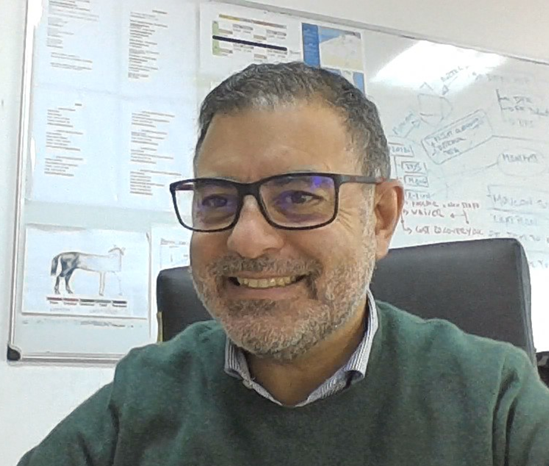
Álvaro Manuel Sosa
Álvaro brings nearly forty years of professional experience in complex and high-pressure environments. His career began with two decades of service as an Air Force officer, including leadership and instructional roles, before transitioning to international work in conflict-affected and multicultural settings across Africa.
Over the past eleven years, he has worked extensively in international humanitarian operations, including several years with the International Committee of the Red Cross (ICRC). He later joined the European External Action Service (EEAS), where he has spent the past six years managing technical support programmes. In his role as Project Manager, he has worked within complex operational frameworks, often liaising with military and security structures.
Throughout his career, Álvaro has combined operational leadership with academic expertise in public administration and international affairs. He holds a Master’s degree in International Humanitarian Affairs from the University of York, a Diploma in Humanitarian Diplomacy, and institutional certifications as a Programme Director and Instructor in the Law of Armed Conflict (LOAC). He is also specialised in International Humanitarian Law.
Fluent in five languages, Álvaro has held senior roles requiring strategic thinking, operational management and adaptability in demanding international environments.
-
After building a very fulfilling 20-year career as an Air Force pilot officer; more than 10 of those years dedicated to my role as an instructor at the academy training military aviators; the pivotal moment leading to my first major professional transition was linked to my experience during an international operational deployment.
That moment came in 2005, when I was sent on a United Nations Peacekeeping Mission as part of an Air Force contingent responsible for conducting medical evacuations by air (MEDEVAC Team) from the border area during the active conflict between Eritrea and Ethiopia.
Facing the challenge of operating within a complex structure, as these missions always are made up of multinational components ,combining civilians and military personnel, with diplomatic and political objectives carried out through military units and assets in the context of armed conflict, was undoubtedly a profound source of motivation for me. It was an opportunity to test both my professional and personal capacities, always guided by the spirit of service in which I had been educated and trained.
From that point onward, and after participating in a second UN Peacekeeping Mission—this time in eastern Democratic Republic of Congo between 2006 and 2008—the signs of a professional shift became increasingly evident.
The possibility of bringing my professional skills closer to the operational field while being more directly connected to the victims themselves became decisive factors in my reflection and decision to pursue a first career transition.
Through a series of circumstances related to the logic of a military career where promotion through the ranks gradually shifts responsibilities from operational activities on the front lines toward strategic responsibilities, often behind desks—and particularly through contact with humanitarian actors in the field and learning about and appreciating their work, the idea of entering the humanitarian world began to emerge as a natural projection in the evolution of my professional life.
The change represented a personal challenge, but it aligned with both my capabilities and my preferences at that stage of my life.
-
Undoubtedly, the greatest challenge was facing the distance from the community that provides emotional reference: family, friends, and comrades. That original support network is irreplaceable for anyone.
I had already experienced separation from family and friends during my military missions, but at that time I still had my fellow soldiers. Within the military organization, you belong by definition to a fairly homogeneous group where shared customs and traditions are cultivated. This provides a very strong sense of identity and support.
However, due to the nature of humanitarian work, field structures usually bring together people from very different backgrounds (with few exceptions of organizations with a purely national character). Therefore, there is a constant need to create community from diversity.
Because of the nature of humanitarian work, these environments are often exposed to high levels of risk and emotional strain; circumstances in which individuals may reach extreme levels of vulnerability. In those situations, both formal and spontaneous support networks become essential.
Consequently, the effort required is greater: in addition to adapting to everything related to the specific mission, it becomes necessary to manage emotional balance to complement, reinforce, or sometimes replace the original support systems that normally provide stability.
Working to help the most vulnerable does not mean that you yourself are invulnerable.
In my case, I was fortunate to work with colleagues with whom we were quickly able to recreate beyond the necessary professional relationship, a network of personal connections. Despite our differences, those differences did not become obstacles or barriers. On the contrary, they helped create an environment of solidarity, safety, understanding, and support.
However, I must recognize that this required significant effort from everyone involved, and that this balance does not always occur naturally. When this emotional constellation does not form, the group weakens and individuals may become exposed to traumatic stress with serious consequences for their psychological stability.
Being fully aware of this and knowing it would likely be the greatest challenge I accepted it as “the personal challenge” of expatriation.
Professional competence alone is not enough if we cannot maintain a reasonably stable emotional balance.
-
I would summarize it in three interconnected concepts: adaptation, curiosity, and alternatives.
A well-developed capacity for adaptation allowed me to integrate into very different systems, tasks, and contexts.
Curiosity, the desire not to limit myself to the immediate situation but to understand things from a holistic or systemic perspective, allowed me to better understand the requirements of my work and to apply principles of total quality to improve organization, methods, and tools, making them more efficient and effective.
This curiosity has also been strengthened by a humanistic approach, through which I have always tried to maintain diverse areas of interest beyond a single specialization.
Finally, I always try to define a central axis for my activities while keeping possible alternatives in mind in case of threats or difficulties.
My training as a pilot likely shaped this way of structuring my career.
A pilot must adapt to highly variable circumstances- such as weather conditions - while remembering that the aircraft itself is a mechanical system composed of multiple subsystems.
If you are curious, from altitude you see the landscape differently. You perceive new perspectives and discover new dimensions. But none of these conditions are permanent or absolute.
Weather conditions may change, or a system may fail at which point contingency plans must be applied.
For this reason, pilots must always have alternative landing options along their route.
-
After more than 10 years in the humanitarian world, I found myself facing a period of significant uncertainty.
Sometimes organizations lack capable leaders, and individuals with problematic behaviors continue to advance despite undermining the work environment and eroding the motivation and dedication that this type of work requires.
Despite having strong indicators and results demonstrating my professional performance, the toxicity generated by leadership within the workplace led me to question the quality of my work and ultimately to doubt my own professional abilities.
At that point, fully aware that more than 30 years of professional experience had consistently demonstrated strong performance, I nonetheless imposed on myself an exercise of deep reflection and analysis to confront this uncertainty.
In 2019, I began by evaluating the history of my career.
Then I reviewed the contextual factors involved in the situation.
Next, I analyzed the strengths and weaknesses of my professional profile.
Finally, I listed my personal strengths and weaknesses.
The results of this analysis were clear:
My professional history did not reveal major issues; the results were overwhelmingly positive.
The negative contextual factor was a clear problem related to poor human management from organizational leadership, something that had evolved from a professional difficulty into a motivational problem.
My professional capacities and potential for developing additional skills remained confirmed, though the exercise also helped me identify areas where I could improve.
I concluded that the uncertainty I felt was largely due to an external factor rather than something inherent to me.
Since the organization itself was unlikely to change, the logical solution was to modify my professional environment.
I once again relied on the resources that have always guided me: reflection and creativity.
I designed an alternative plan, remained curious in exploring possible solutions, and strengthened my capacity to adapt to another transition.
It was both an ambitious and beneficial challenge. It restored my self-confidence and confirmed that my professional abilities still had significant potential to be developed and applied.
With recalibrated professional tools and renewed confidence in my values, I entered the diplomatic service, where for the past six years I have managed a technical assistance program.
What initially appeared as a crisis became a reflective pause that proved highly beneficial.
-
When I was a child, I saw a phrase on a poster that read:
“Those who fight without dreaming are useless. Those who dream without fighting never arrive.”
I believe this phrase captures the balance we must maintain in professional life.
We must be conscious of how much and how we offer our abilities, our work, our dedication, and our time.
To anyone facing professional transitions, or even those who believe their career is completely secure (which I doubt truly exists nowadays), I would say that we must always check our course and adjust according to the wind.
Ask yourself whether you truly feel fulfilled with the life you are living, professionally and personally and evaluate honestly the value of your contribution.
Do not exaggerate what you can offer, but never allow anyone to diminish the genuine value of your commitment and capabilities.
Another observation I would make is that while the military system can also have deficiencies in human resource management, it is often more effective than many other large organizations.
The dynamics of a military career require careful management of human resources. Leaders must be prepared to move to higher levels after having experienced subordinate operational roles.
In some organizations, however, leadership positions are not always filled by individuals trained to lead.
A person may have excellent technical abilities and strong individual performance yet lack the soft skills necessary to manage teams effectively.
During my humanitarian missions, I encountered many colleagues with strong professional backgrounds and genuine commitment who nevertheless developed impostor syndrome as a result of poor management from their supervisors. This led to frustration, demotivation, stress, reduced creativity, and lower productivity.
I can say with certainty that the most satisfying, exciting, and productive moments of my career were those where teams were built on mutual respect and the recognition of each individual, prioritizing the development of the three fundamental Cs: Communication, Cooperation, and Coordination.
In conclusion, while academic and technical training are necessary and important, personal skills are essential for navigating professional challenges.
Aptitude does not always work if it is not accompanied by attitude.
Ideally, our professional activities should genuinely reflect our abilities and interests, enabling us to achieve emotional stability while feeling confident that we are serving others in a meaningful, creative, and useful way.
Ready for your own evolution?
Alvaro’s story highlights that while the journey is personal, the tools you use matter. Whether you are moving toward HQ or entrepreneurship, you must learn to speak the language of your next chapter.
[Download the Humanitarian CV Playbook & See the Full March Series]
This interview is part of The Humanitarian Pivot, a special March series exploring the diverse career evolutions of aid workers: from field-to-HQ moves to entrepreneurship. To see the full series clic here
