
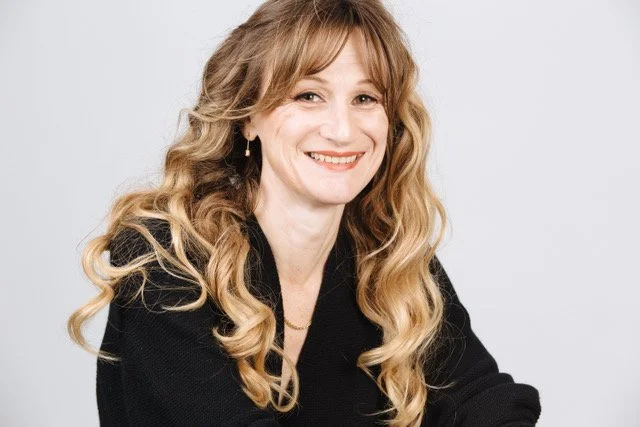
Claire Peltier
is a former humanitarian professional and leadership guide whose career bridges the art world, humanitarian action, and consciousness-based leadership. After ten years working at Christie’s across London, Paris, and New York, she felt called to contribute to the humanitarian sector and joined the International Committee of the Red Cross, where she spent another decade working in and around conflict-affected contexts.
Confronted firsthand with extreme violence and war, Claire reached the limits of what the mind alone could process. This experience became a turning point, leading her on a deep personal and professional journey to understand trauma, life purpose, and human resilience. In 2018, she founded her own practice, where she now supports purpose-driven leaders, humanitarians in transition, and conscious professionals to transform inner blockages into aligned leadership, finding their inner power and embodied change. She mapped out the journey to self-discovery that she helps her clients go through, called “the Intelligent Power journey framework”. To know more about Claire, you can visit her website.
Q1: When did you first realize that a professional transition had become necessary?
I actually saw it coming ahead of time and had time to prepare. At some point, I felt a strong internal disconnect. It wasn’t that the humanitarian world did not matter anymore, but rather that I had to do things differently.
I understood clearly that my path was elsewhere. I also felt misaligned with how the organization I was working for was changing. Institutions do change, and that’s ok, but it was no longer for me.
Externally, things were fine; I could have carried on for a while, perhaps with shorter missions.
I must say that, I have a strong intuition. When I joined the International Committee of the Red Cross (ICRC) in 2007 after a previous career change, I knew it would be for about ten years and that after that, I would be doing something else forthe rest of my life . Having gone through a transition before, I recognized the signs that it was time to move on. It was purely a personal decision, listening to my inner call.
Q2: What was the most challenging part of this transition beyond the practical or technical aspects?
There was quite a lot, actually.
In order to follow my inner call, I had to train, which started with Yoga and Qigong. I also moved back to France, a country I had left 25 years prior. Starting a business there is not easy, and I didn’t have a network. I often compared it to arriving in a foreign country to do something completely new; I only spoke the language.
The sense of security was also challenging. While I had savings and stayed with my mother for a while, starting a business feels insecure. You don’t know when or if it will take off.
You need a high risk threshold and a willingness to fail often.
I had no problem shifting identity. In retrospect, I probably had a strong attachment to the organisation at the beginning that later eroded. For the best, I guess, I still admire what the teams are doing in the fields, but I knew my life was not there.
Maybe the hardest part for me, and again it is due to my settling as an independent, is that I was on my own: the solitude of being an independent. You have to figure out the what, how, when, and why entirely by yourself. When you face doubts, you mostly go through them alone. I found it difficult to take a step back, and I put too much pressure on myself at times.
Are you navigating a similar "inner call"? Translating years of field experience into a new venture or HQ role starts with clarity. Download the Humanitarian CV Playbook [here] to start mapping your skills.
Q3: Which skill or experience from your previous chapters turned out to be more valuable than you expected?
Having changed careers once before was a strong asset for self-confidence. I knew how to unravel my path and rebuild it. That previous transition from the auction world to the humanitarian world was key to my self-trust.
It proved that I could navigate change, learn a new environment, and succeed. For me, self-trust is the key to transition and it goes hand-in-hand with discernment. I also knew my values and that if I am aligned, I can do what I want (giving it time!).
Beyond self-trust, my main valuable skills proved to be:
Adaptability and taking risks.
The willingness to fail and learn.
Project management, responsibility, and commitment.
Q4: Looking back, was there a period of uncertainty that later proved to be structuring?
When the feeling came of ‘it is time to leave’, I took 2 months off (I was on a mission contract, so that was easy) to think it through. After that, it was clear that it was time to move on, but it was too early, and I needed to figure out the next step in detail - it still felt a bit blurry and vague at that time. I knew I needed some training, but it wasn't clear enough on what.
So I went on another mission, meant to be a short one, but that ended up lasting 9 months. Giving me a bit more time all worked out very well. I continued researching what to do next and how to do it. After that, I felt ready, despite the remaining uncertainties. I guess I had the first next step and clarity about what I wanted to do. Then I trusted that I would find answers and resources on the way!
The decision to come back to France was not planned, though. I grew tired of moving around and suddenly decided to settle. And that protected me, a sort of ‘going back home’ (although I have never felt very close to France). It felt right, and I thought that if I want to move again after a while, I can. In the end, it was the right move, the right place to be in that environment. I gave myself the foundation to develop my structure.
Q5: If you were speaking to someone exactly where you were before your transition, what would you tell them?
There are some individual factors, so I'd say know yourself, figure out what you want to do and how, and what lifestyle you want. You have to consider your status, whether you are single or with family and how much financial freedom you have.
The Inner Work
In knowing yourself, you also should consider what amount of risk you can bear financially, emotionally, security-wise. Are you prepared to take a full year or several and decide for yourself, or do you need more security?
We are all different, and the best advice I could give (and the one I give to my clients now) is to know yourself, go deep, know your needs and what blocks you, and learn to face your fears.
Getting Support
I would also recommend getting some help. If you are not sure what you want to do or have never been through the process, someone from the outside is a great help in figuring it all out. I had my first career change in 2006 and later delved into personal development, receiving coaching while with the ICRC. They proved to be extremely valuable.
Then, if you want to start your business, having someone to help you along the way is critical, as running a business(even as a coach) is a totally different ballgame than working for a company or institution. Depending on what you do next, you may need training in your field of expertise.
The Logistics of Change
Do think about your network, nurturing it and developing it all the way so that when the time comes, you don’t fall short.
And lastly, know that no matter how sure you are about your change and your next move, you will face moments of doubt, and things may not click exactly the way you want when you start. That is normal!
Career transition is about personal growth; it is an intimate journey of finding yourself, your purpose, and making it real. It is a deep one worth taking time to look into if you want to make the most of it.
So I wish you all the best on this wonderful journey!
For those who are into intuition, I have created a small booklet to help you learn to use and recognise your intuition. You can download it here.
Ready for your own evolution?
Claire’s story highlights that while the journey is personal, the tools you use matter. Whether you are moving toward HQ or entrepreneurship, you must learn to speak the language of your next chapter.
[Download the Humanitarian CV Playbook & See the Full March Series]
This interview is part of The Humanitarian Pivot, a special March series exploring the diverse career evolutions of aid workers: from field-to-HQ moves to entrepreneurship. To see the full series clic here
